Watching the coolant temperature gauge climb toward the red zone while hauling a loaded trailer is one of the most stressful moments on the road. Knowing exactly what to do when an engine is overheating protects your cylinder head, prevents a cracked block, and keeps you safe on the highway shoulder.
This guide walks you through the immediate cab actions to take first, the federal roadside safety steps, how to inspect the cooling system without getting burned, and how diesel technicians narrow down the root cause.
Immediate Steps to Take in the Cab
When you see the temperature needle climbing past its normal range or a high coolant temperature warning illuminates, your first goal is to reduce heat load and get the truck to a safe stop. Never ignore a dashboard alert, as Kenworth operator manuals warn that continuing to operate through critical engine warnings can cause severe equipment damage.
- Ease off the throttle immediately. Reducing engine load cuts combustion heat right away. If you are climbing a long grade, downshift to keep engine speed in a healthy cooling range while lowering fuel demand, rather than lugging the engine in a high gear.
- Switch off the air conditioning. Turning off the A/C removes compressor load from the engine and stops the A/C condenser from dumping extra heat directly in front of the radiator core, as outlined in heavy commercial emergency guidance from Vaden Original.
- Turn the cab heater and blower fan to maximum heat. Your heater core acts like a small secondary radiator. Pulling hot coolant through the cab heater helps bleed a small amount of heat away from the engine while you look for a safe place to stop.
- Watch your oil pressure and voltage gauges. If the oil pressure warning or battery charge light comes on alongside high coolant temperature, you may have lost a drive belt or suffered a mechanical failure. In that case, pull over and shut the engine down immediately.
- Pull over to a safe, level location. Look for a wide highway shoulder, rest area, or exit ramp. Avoid stopping in the middle of a steep grade or blind curve whenever you can safely reach a better spot.
Should You Idle or Shut the Engine Down?
Whether to idle briefly or shut off the engine right away depends on what the truck is doing when you stop.
- Shut the engine off immediately if you see heavy steam from under the hood, hear loud knocking or belt squealing, see a rapid drop in oil pressure, or receive a red Stop Engine lamp. Continuing to run an engine that has lost coolant or coolant flow accelerates internal damage.
- Idle briefly only if temperature stabilizes. If the gauge climbed slightly on a steep pull, no steam is visible, oil pressure is normal, and your cooling fan is roaring, shifting into neutral and letting the engine idle with the hood closed for a minute or two can help circulate coolant through the radiator. If the temperature does not begin dropping right away, shut the engine off.
Secure the Truck Before Opening the Hood
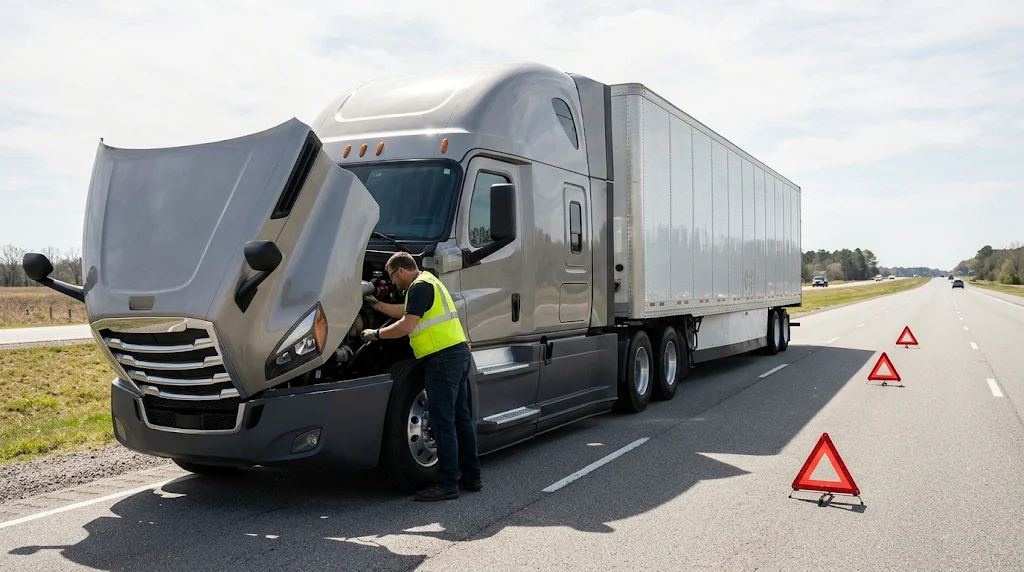
Commercial roadside breakdowns carry serious traffic risks. Under FMCSA regulation 49 CFR 392.22, you must turn on your hazard warning flashers immediately when stopped on a highway or shoulder for any reason other than a normal traffic stop.
As an Amazon Associate I earn from qualifying purchases.


Set your parking brakes, put on a high-visibility vest, and place your three bidirectional reflective warning triangles within 10 minutes of stopping:
- On a divided or one-way highway: Place one triangle within 10 feet of the rear on the traffic side, one at 100 feet, and one at 200 feet toward approaching traffic in the center of the occupied lane or shoulder.
- On a two-lane undivided road: Place one triangle 10 feet (about 4 paces) from the truck on the traffic side toward approaching traffic, one at 100 feet ahead, and one at 100 feet behind.
- Near hills, curves, or view obstructions within 500 feet: Place the triangle in the direction of the obstruction at a distance of 100 to 500 feet so approaching drivers have adequate warning.
Wait for the engine to cool down before doing any close inspection. Never reach under the hood while the engine is running, because heavy-duty cooling fans and wide drive belts can cause severe injury if an air-controlled or viscous fan clutch engages unexpectedly.
What You Must Never Do With an Overheating Engine
Making the wrong move on the shoulder often causes more harm than the original fault.
- Never open the radiator or surge tank cap while the engine is hot. Heavy-duty cooling systems operate under pressure to raise the boiling point of coolant. Both the Detroit Diesel Medium Duty Operator Manual and the Daimler Truck North America Maintenance Manual warn that removing a pressurized cap before the system cools can release a sudden surge of scalding coolant and steam.
- Never pour cold water into a hot engine. Sudden temperature shock can warp a cylinder head or crack an engine block. Always wait until the engine has cooled completely before adding fluid.
- Never clear a fault code and keep driving. Resetting a dash warning or cycling the key does not fix a cooling failure and can lead to engine seizure.
- Never add stop-leak sealants on the roadside. Chemical sealants can plug narrow radiator tubes, oil coolers, and EGR cooler passages, turning a manageable repair into a major tear-down.
Safe Visual Checks Once the Engine Cools
After the engine has been off long enough for the upper radiator hose to feel cool and soft to the touch, you can perform basic visual checks safely.
Check Coolant Level and Look for Leaks
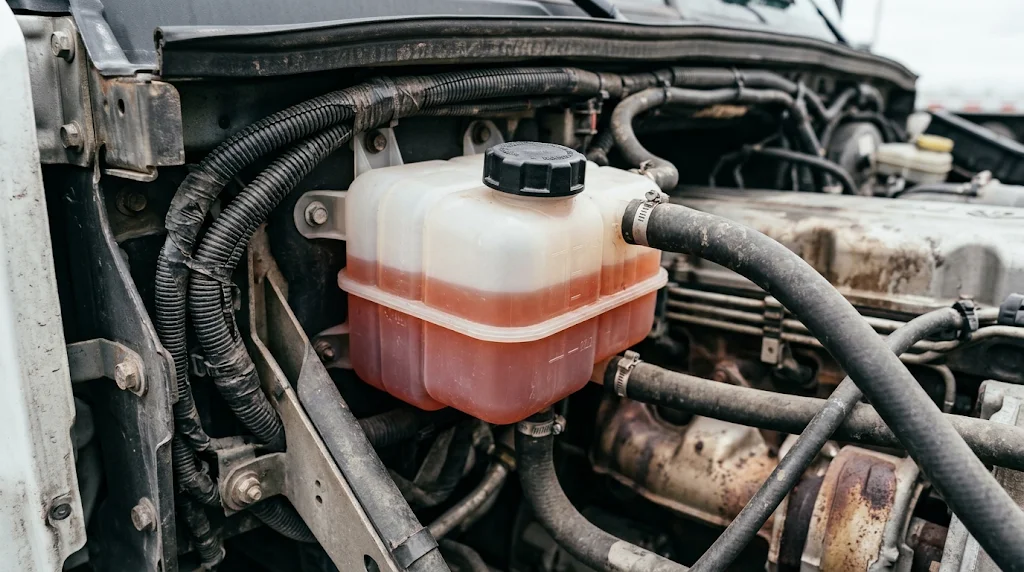
Start by looking through the translucent surge tank without removing the cap. Check whether the coolant sits near the cold fill mark or if the tank is empty.
Walk around both sides of the engine bay and check underneath the truck for wet spots, puddles, or dried crusty coolant trails. Pay close attention to radiator hose clamps, the water pump weep hole, the thermostat housing, and the bottom seams of the radiator. On modern diesel platforms such as the Cummins ISX, cooling system guides note that EGR cooler connections, water pump seals, and thermostat housings are frequent leak points.
If you also pull the engine oil dipstick after cooling, look for a milky or frothy brown emulsion. Coolant mixed into the oil points to an internal leak such as a failed head gasket, oil cooler, or cylinder liner seal. If you see contaminated oil, do not restart the engine and arrange a tow.
Inspect Radiator Airflow, Belts, and Fan Clutch
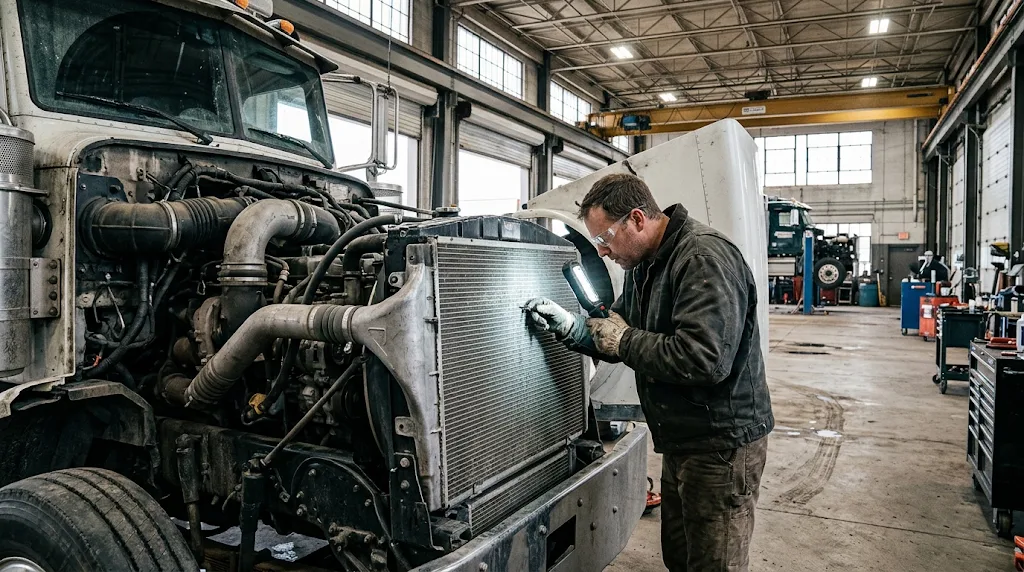
With the engine off, shine an inspection light through the front grille, A/C condenser, charge air cooler, and radiator core. Heavy bugs, cottonwood fluff, mud, or road debris packed between the stacked coolers can choke off airflow even when the rest of the cooling system is healthy.
Next, inspect the serpentine drive belts for cracking, glazing, fraying, or missing ribs. A snapped or slipping belt can stop the water pump or fan drive from turning properly. Check the fan shroud as well, because a cracked or missing shroud stops the fan from pulling air evenly across the radiator core.
Common Causes of Heavy-Duty Truck Overheating
When I approach an overheating complaint, I look at when the temperature spikes. The driving pattern gives strong clues before a wrench ever turns.
| Symptom Pattern | Most Likely Causes to Check First | Why It Happens |
| Overheats in stop-and-go traffic or at idle, cools on highway | Fan clutch failure, air supply issue to fan hub, damaged fan shroud, or faulty fan solenoid | At low speed, the truck relies on the fan rather than forward ram air |
| Overheats mainly on grades or under heavy load | Plugged radiator fins, restricted internal radiator core, stuck thermostat, weak water pump, or EGR cooler issue | High fuel burn creates maximum heat that a partially restricted system cannot shed |
| Temperature climbs rapidly right after startup or with no cab heat | Low coolant level, air pocket trapped in the system, failed water pump, or snapped drive belt | Coolant is not circulating through the engine block and heater core |
| Gradual coolant loss with white sweet-smelling exhaust smoke | Leaking EGR cooler, blown head gasket, or cracked cylinder head | Coolant is entering the combustion chamber or exhaust stream |
| Gauge spikes suddenly while engine hoses feel normal | Faulty coolant temperature sensor or damaged wiring harness | The engine control module reads an inaccurate voltage signal |
Modern heavy-duty trucks use SAE J1939 standard Suspect Parameter Numbers (SPN) and Failure Mode Identifiers (FMI) alongside manufacturer-specific fault codes. A fault code tells you what condition the engine control module detected, not automatically which part to replace.
| Standard J1939 Code | Example OEM Mapping | General Meaning | Diagnostic Takeaway |
| SPN 110, FMI 15 | Cummins FC 2963 (ISX15 2013 to 2018) | Engine coolant temperature above normal range, warning level | Early warning to reduce load and inspect cooling performance (Diesel Laptops) |
| SPN 110, FMI 16 | Cummins FC 146 (ISX15 2013 to 2018) | Engine coolant temperature above normal range, moderately severe | Cooling limit exceeded, derate may begin depending on calibration (Diesel Laptops) |
| SPN 110, FMI 0 | Cummins FC 151 | Engine coolant temperature above critical protection limit | Triggers progressive power and speed derate and may initiate a 30-second engine shutdown if enabled (Cummins QuickServe FC 151) |
| SPN 111, FMI 1 or 18 | Detroit FMI 1, Cummins FMI 18 | Engine coolant level low or very low | Low surge tank level detected by level probe, can trigger engine protection (EquipmentFinder) |
| SPN 111, FMI 2 or 4 | Cummins FC 422, International FMI 4 | Coolant level sensor circuit erratic or voltage below normal | Points toward a sensor, connector, or wiring problem rather than confirmed fluid loss |
Exact temperature thresholds and derate schedules vary by engine manufacturer, emissions generation, and fleet ECM programming. For example, documented Cummins fault code 151 specifications list critical alerts above 219 degrees Fahrenheit (104 degrees Celsius) on certain models, while other engine families and model years use different setpoints. Always check the service literature for your specific engine serial number.
Step by Step Cooling System Diagnosis
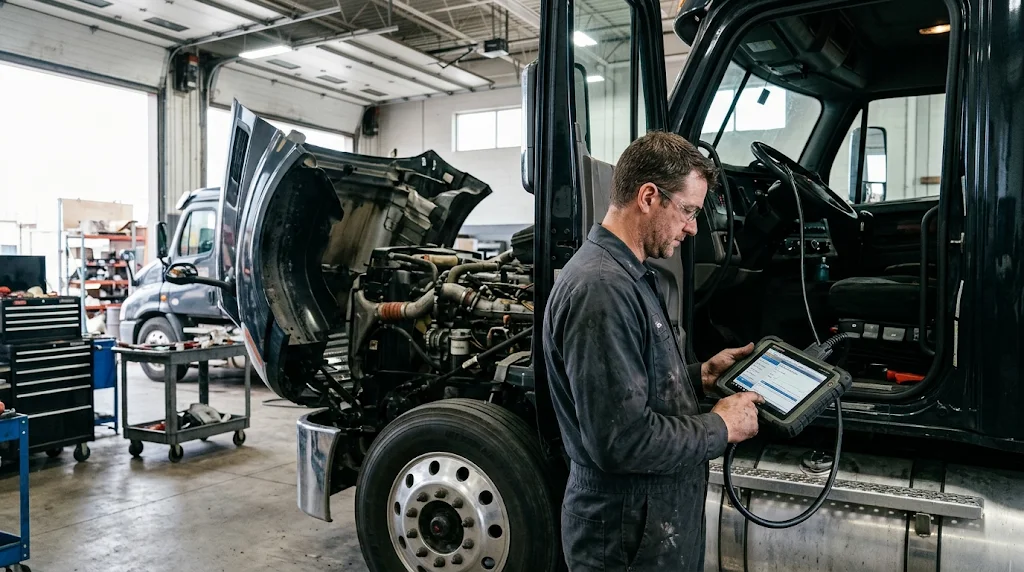
Once the truck is safely at a shop or roadside service location, we want to rule out simple faults before replacing expensive components.


- Read active and inactive fault codes. Use a heavy-duty diagnostic scanner to pull J1939 and OEM codes. Compare live coolant temperature readings against an infrared thermometer aimed at the thermostat housing to confirm whether the sensor is telling the truth.
- Test the surge tank pressure cap. A weak cap allows coolant to boil at a lower temperature and push out through the overflow. DTNA maintenance guidelines call for testing the cap to verify it holds pressure within 10 percent of its marked rating, such as 15 psi on many Cummins CM2250 and CM2350 applications.
- Perform a cooling system pressure test. Pressurizing the cold system to the cap’s rated pressure reveals weeping hoses, radiator seams, water pump seals, and hidden clamps without running the engine.
- Command and test the cooling fan. With diagnostic software, a technician can command the fan clutch on and off to verify air supply, electrical solenoid operation, and clutch engagement.
- Check thermostat operation and coolant flow. Compare upper and lower radiator hose temperatures as the engine warms up. A large temperature mismatch or a cold radiator while the engine runs hot points toward a stuck closed thermostat or a failing water pump impeller.
- Test for combustion gases in the coolant. If no external leak is found and coolant still disappears or builds excessive pressure, a block test for combustion gases or an EGR cooler pressure test helps separate an EGR cooler failure from a cylinder head or head gasket leak.
Repair Solutions and Engine Differences
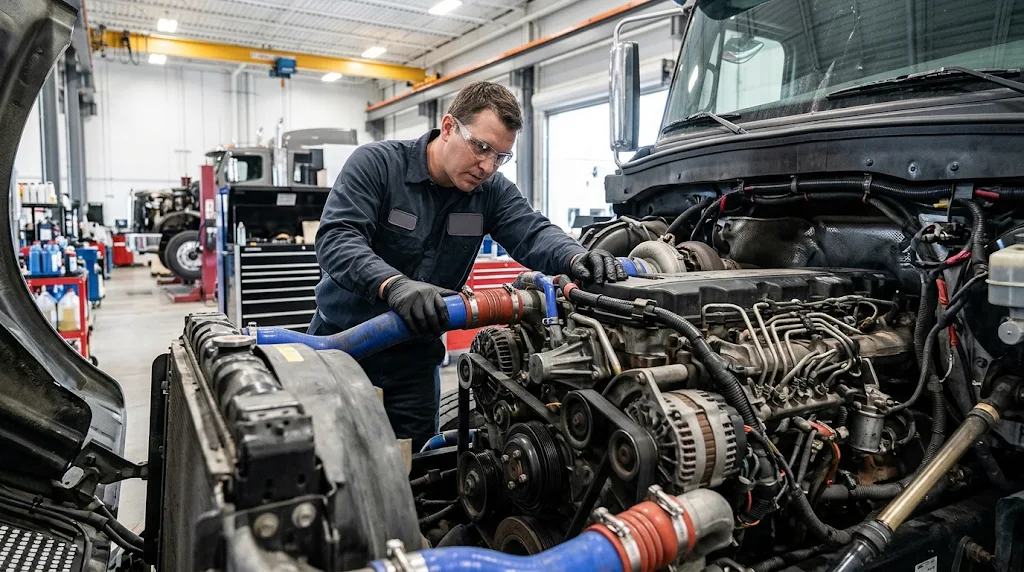
The right repair depends entirely on what the diagnostic tests confirm. Common fixes range from straightforward maintenance items like replacing a worn pressure cap, flushing packed radiator fins with low-pressure air or water, or replacing a stuck thermostat, up to larger repairs such as a water pump, air-actuated fan clutch, radiator core, or EGR cooler.
If you clean radiator fins with compressed air, remember that Detroit Diesel safety guidelines specify wearing eye protection and keeping air pressure at or below 40 psi (276 kPa) so you do not bend delicate aluminum fins or cause injury from flying debris.
Keep in mind that heavy-duty trucks are not all built alike. A Kenworth T680 might run a PACCAR MX-13 or a Cummins X15, while a Freightliner Cascadia typically runs a Detroit DD15 or a Cummins platform. Thermostat counts, opening temperatures (often around 180 degrees Fahrenheit on Cummins ISX models), cap pressure ratings, bleeding procedures, and approved extended-life coolant formulas differ across engine families.
The exact procedure depends on the engine and model year. Check the applicable manufacturer’s service information and verify your VIN, engine serial number, and component part number before purchasing parts or performing this repair.
Can You Drive a Truck After It Overheats?
Do not drive the truck if the red Stop Engine lamp is active, coolant is visibly leaking, the drive belt is broken, or the engine has entered thermal derate. As Freightliner Cascadia driver manuals emphasize, low coolant and high temperature conditions trigger protection shutdowns specifically to prevent catastrophic engine failure.
If the truck only ran warm on a heavy climb, no leaks or steam are present, the coolant level in the surge tank is full once cool, and the temperature returns to normal, you may be able to limp gently to the nearest repair facility while watching the gauge closely. If the gauge starts climbing again, stop immediately and call for roadside assistance or a tow.
Repair Cost Considerations
Repair costs vary widely based on the confirmed failure, engine model, shop labor rates, and whether roadside callout or towing is required. Replacing a pressure cap, hose clamp, or coolant temperature sensor is usually an inexpensive, quick job. Replacing a thermostat, fan clutch, or water pump sits in the moderate range, while a radiator assembly, EGR cooler, or cylinder head repair represents a major expense.
Spending money on an accurate pressure test and diagnostic scan first is almost always cheaper than guessing and replacing a thermostat or water pump when the real problem is a clogged radiator stack or failing fan solenoid.
How to Prevent Engine Overheating?
Consistent preventive maintenance stops most overheating breakdowns before they happen.


- Check coolant level during every pre-trip inspection while the engine is cold.
- Use only the manufacturer-approved coolant chemistry, typically a 50/50 premix of approved extended-life coolant and deionized water, and test inhibitor levels at scheduled intervals.
- Inspect and clean the radiator and charge air cooler stack regularly, especially during spring and summer bug seasons or after dusty construction work.
- Check serpentine belts, tensioners, and hoses for wear, soft spots, or weeping clamps at every PM service.
- Log repeat warm-running events. If a truck runs hotter than usual on the same highway grades, schedule a shop inspection before it turns into a roadside derate.
For more practical truck maintenance resources, explore The Truck How or submit a specific truck question through our Ask Question page.
When Professional Help Is Necessary
Call a qualified heavy-duty diesel technician or mobile roadside service right away if you notice:
- Active coolant leaks you cannot safely isolate or repair.
- Milky engine oil or persistent white exhaust smoke.
- Repeated high-temperature derates or red Stop Engine warnings.
- A non-engaging fan clutch or suspected internal EGR cooler or head gasket failure.
Safety-critical cooling repairs and pressurized system diagnostics should be handled by a trained diesel technician using proper personal protective equipment and manufacturer service manuals.
Frequently Asked Questions
Wait until the engine and cooling system have cooled completely rather than relying on a fixed number of minutes. Large heavy-duty diesel engines hold heat much longer than passenger cars. Only loosen the cap slowly using protective gloves after the upper radiator hose feels cool and easy to squeeze by hand.
In a true roadside emergency after the engine has completely cooled, adding clean or distilled water can help you reach a nearby repair shop if approved premixed coolant is unavailable. However, plain water dilutes corrosion inhibitors and lowers freeze and boil protection, so you must have the system drained, flushed, and refilled with the correct manufacturer-specified coolant mixture as soon as possible.
Overheating under heavy load on grades usually means the cooling system cannot reject peak heat fast enough. Common culprits include dirt and bugs packed between the charge air cooler and radiator, a partially clogged radiator core, a thermostat not opening fully, a slipping fan clutch, or combustion gases entering the coolant through a failing EGR cooler or head gasket.
A faulty coolant temperature sensor does not directly make the engine hot, but it can send false high readings to the ECM that trigger derate or false low readings that prevent the ECM from engaging the cooling fan when needed. A mechanic can verify sensor accuracy quickly by comparing scanner data against an infrared temperature reading.
Only idle briefly if there is no steam, oil pressure is normal, coolant is not leaking, and the temperature begins dropping right away. If the gauge stays high, continues climbing, or a red Stop Engine warning appears, shut the engine down immediately to avoid warping the cylinder head.
Final Thoughts
When a truck engine starts overheating, quick and calm decisions make the difference between a minor service stop and a five-figure engine rebuild. Cut the load, get safely off the road with your hazards and warning triangles deployed, never open a hot pressurized cap, and let proper testing guide the repair rather than guesswork.