
How to Start a Semi Truck With a Bad Starter
If your semi truck will not crank, do not assume the starter is dead. Most no-crank problems start with the batteries or the cables, so I would check those first. They are the cheapest fix and the most common cause.
When I approach a truck that will not start, I listen first, then test the batteries, then test the cables. Only after those checks pass do I point at the starter. That order comes from Delco Remy, which builds starters for heavy-duty trucks. If it starts with a jump, drive to a shop the same day. A jump start is a rescue, not a repair.
Safety first
Batteries release explosive gas, so never smoke near them, keep sparks and flames away, and do not lean over a battery while you connect cables. Take off rings and watches before battery work. Set the parking brake and confirm neutral before every starting attempt. If you smell burning or see smoke, stop and step away. A starter cranking against a seized engine can overheat fast and catch fire. Never work under a truck held up by a jack alone.
What the starting sound tells you
Turn the key and listen. The sound tells you where the problem probably sits.
Rapid clicking, like a machine gun, with dimming dash lights usually means the battery is too weak to hold the starter solenoid closed. That is most often a battery or connection problem, not a dead starter.
One solid click and then silence usually means the solenoid engaged but the motor did not turn. That points toward the starter, or a nearly flat battery. Bright dash lights during that click point to the starter.
A grinding noise means the starter pinion gear is not meshing cleanly with the flywheel ring gear. Stop cranking right away, or the grinding will chew up the ring gear teeth.
A slow, laboring crank that gets worse in cold weather usually means a weak battery or high resistance in the cables. No click and no lights at all points to a fully flat battery, a disconnected main cable, or a tripped battery disconnect switch. Check the switch first.
Check the batteries and cables first
A semi truck usually carries more than one 12 volt battery wired together, so one bad battery can drag the whole bank down. A battery can show healthy voltage on a meter and still fail under load, so a voltage reading alone is not enough.
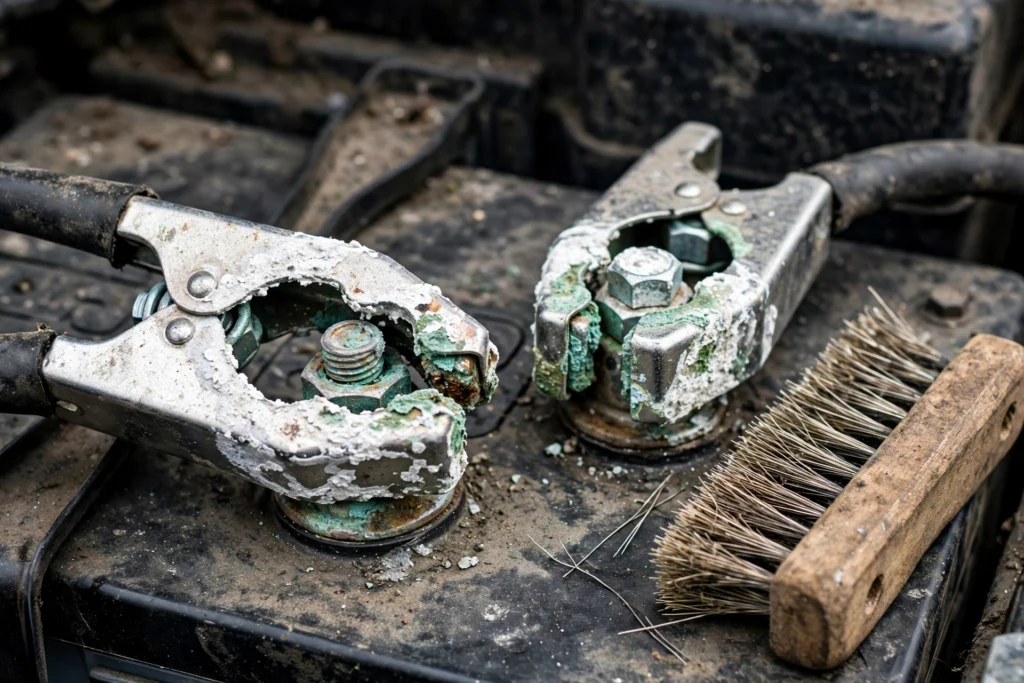
Open the battery box and check each terminal. White or green crust, or a cable clamp you can twist by hand, is enough to stop a truck from starting. Clean the terminals with a wire brush and tighten the clamps. Check the ground cable where it bolts to the frame, too.
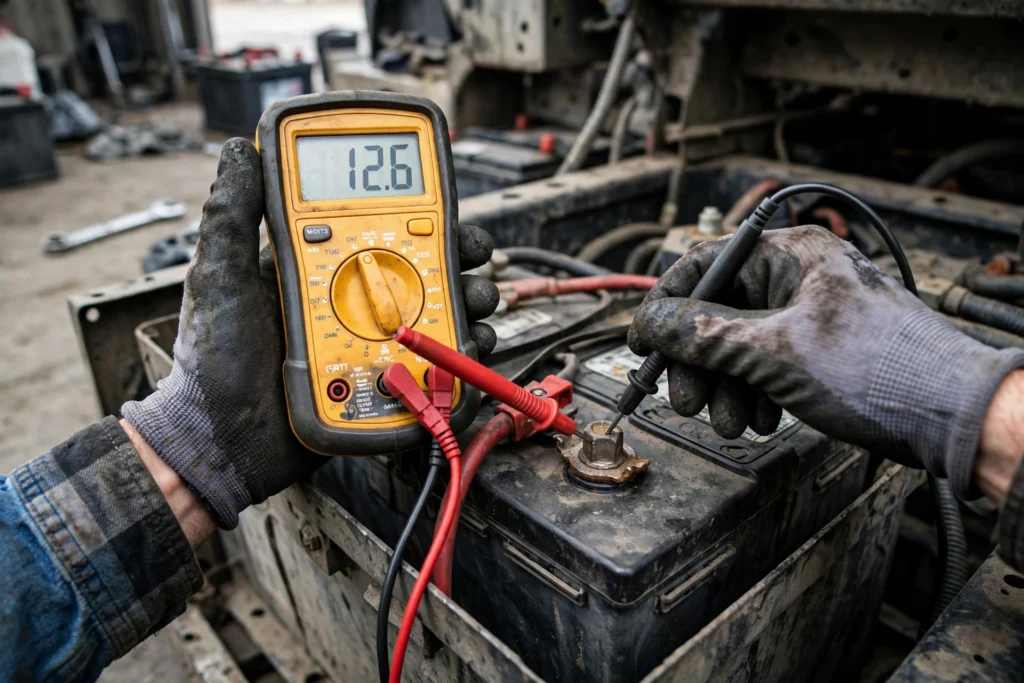
Test the voltage with a digital multimeter set to DC volts. A 12 volt battery should read at least 12.4 volts at rest, and a healthy reading sits between 12.4 and 12.6 volts. Below 12.4, charge the batteries before testing anything else. If they will not hold a charge, have each one load tested on its own and replace the one that fails.
If the batteries pass, test the cables with a voltage drop test, the step most drivers skip. Connect the meter across the battery positive post and the starter main terminal, then have a helper crank the engine. Do the same on the negative side and add the two readings. On a 12 volt system the total drop must be under 0.5 volts while cranking. A higher reading means corrosion, a loose terminal, or a damaged cable is stealing power, so fix the cable first.
Good batteries and cables plus a slow crank means the starter is the cause. One click with a strong battery points to the solenoid or motor.
How to jump-start it the right way
A jump start can get you moving if you do it the way the truck maker describes. These steps follow the Kenworth T680 and Freightliner New Cascadia manuals. If your manual says something different, follow your manual.
Park the donor truck close to yours, but do not let the vehicles touch. Confirm both trucks run on the same system voltage. Most Class 8 trucks are 12 volt systems, and a 24 volt booster on a 12 volt truck will cause expensive damage. Use heavy-duty jumper cables rated for diesel trucks, or a diesel-rated portable jump pack. A diesel-rated portable jump starter or a heavy-duty jump box for diesel trucks is worth carrying before you need one.
Set the parking brakes on both trucks and turn off every light, heater, radio, and accessory. Remove rings and watches before you connect anything. If your truck has underhood jump start posts, use those posts instead of the batteries.
Connect the red positive cable to your dead battery first, then to the donor battery. Connect the black negative cable to the donor battery, then the other end to a clean, unpainted ground on your truck frame or engine block, away from the battery. Do not let the clamps touch each other.
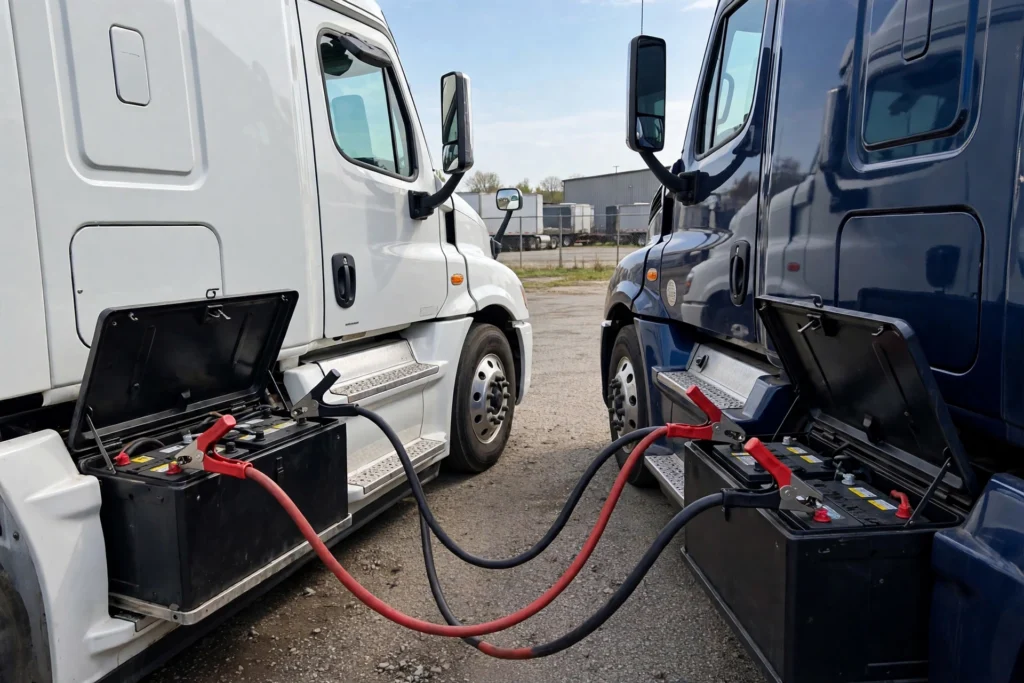
Start the donor engine, and let it run for about five minutes to charge your batteries (15 minutes if your truck has an engine start module). Then try to start your truck. Do not crank for more than 30 seconds at a time, and wait at least two minutes between attempts so the starter can cool. If the truck does not start after two or three tries, stop and call for service.
Once your truck is running, let it idle for a few minutes, then disconnect the cables in the exact reverse order. Remove the negative cable from your truck frame first, then the negative from the donor, then the positive from the donor, then the positive from your truck. Get the batteries and charging system tested the same day.
The tap trick, as a last resort
If the batteries and cables test good and you still get one click, the solenoid may be stuck or the motor brushes may have a dead spot. A few light taps can sometimes free it for one start. This is a last resort, not a fix.
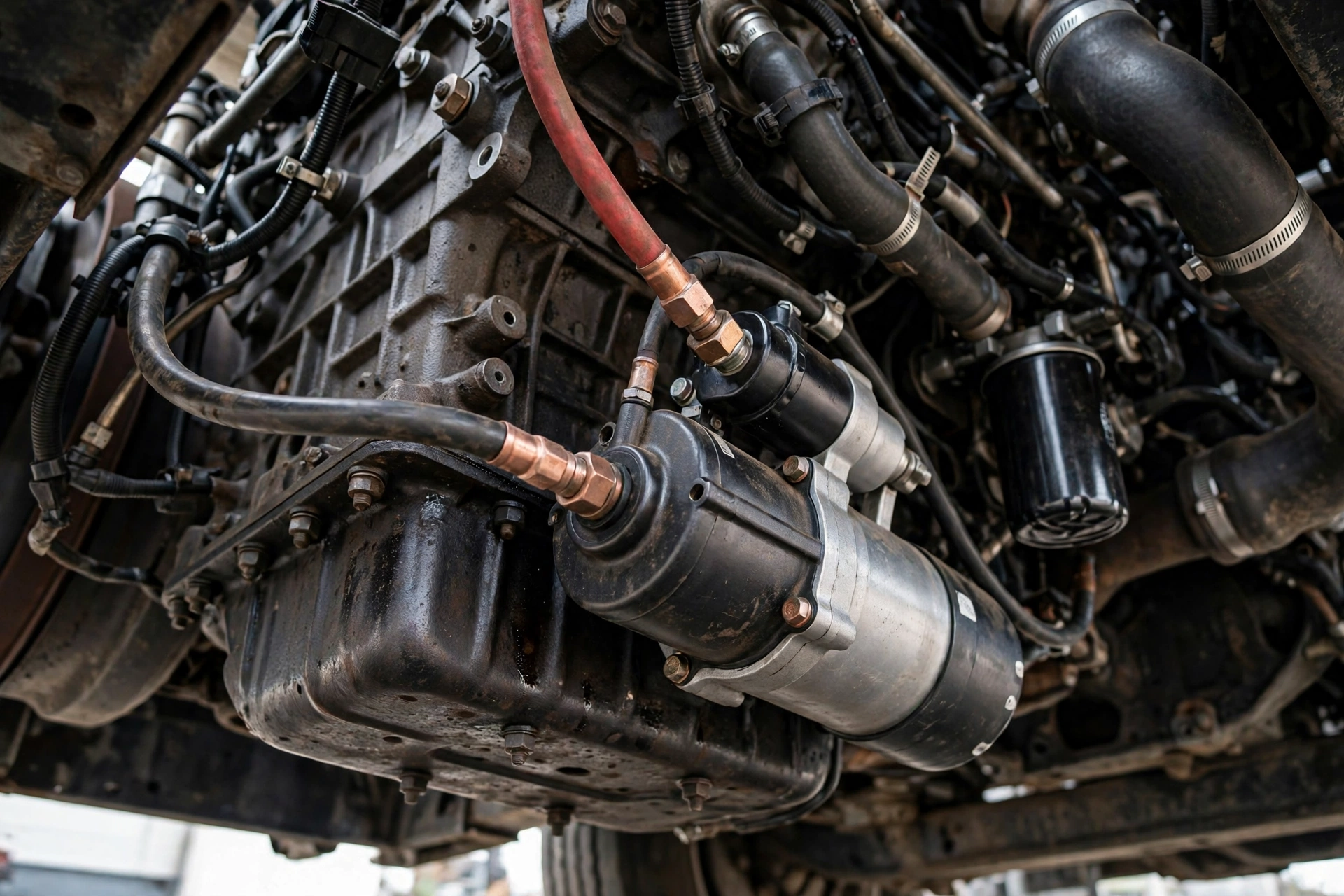
Set the parking brake and confirm neutral first. Find the starter where the engine meets the transmission. Tap the solenoid housing with the wooden handle of a hammer or a rubber mallet. Use a few firm but gentle taps, not heavy blows. A hard hit can crack the cast housing or damage the magnets inside. Then have a helper turn the key right away.
If the truck starts, drive straight to a shop. The tap only proves the starter is failing, and it can quit again at the next stop. If tapping does not work after two or three tries, stop.
What not to do
Some roadside advice will damage your truck or put you in danger.
Do not pry on the flywheel with a crowbar to turn the engine. A crowbar can chip or break ring gear teeth, and forcing the engine over by hand is not a starting method. The correct tool is an engine barring tool, used by a technician.
Do not roll the truck downhill and pop the clutch to push-start it. Diesel engines need high compression and electrical power for the engine computer and fuel system, so a rolling start often fails. Worse, a semi truck’s spring brakes need air pressure from the engine-driven compressor, so you cannot be sure the truck will stop once it rolls. Automatic transmissions cannot be push-started at all, because their torque converters need the engine running to pump fluid.
Do not bypass the ignition switch with jumper wires or a screwdriver across the solenoid terminals. This sends full battery current through an improvised connection and bypasses the safety interlocks. If the truck is in gear, it can lurch forward.
Do not keep cranking a truck that will not start. Holding the key for long cranks overheats the starter motor and drains the batteries. If two or three short attempts fail, stop and find the cause.
When to call for help
Call a mobile mechanic or a tow when the problem is beyond a battery or cable check. Get help if you smell burning or see smoke, if the starter keeps grinding, if it spins without turning the engine, or if the truck starts and dies again right away. Get help too if you have no multimeter, no safe place to work, or no helper. Towing is the right call when the truck cannot be started safely, when the brakes cannot be released, or when you are on a roadside without room to work.
Replacing the starter
When the diagnosis points to the starter, the fix is a replacement, not a roadside patch. Match the new starter to your truck’s make, model, year, and engine, because starters differ in mounting, tooth count, and rotation. Disconnect the batteries before anyone touches the starter cables. The old unit is heavy and sits low on the engine, so this is a shop job for most drivers.
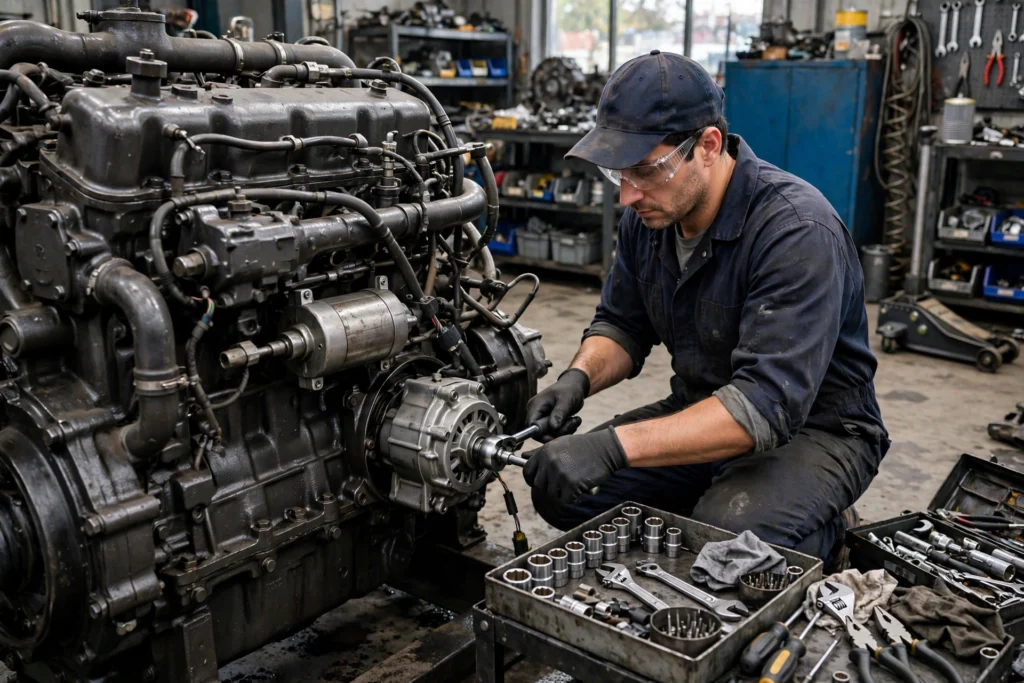
Ask the shop to inspect the flywheel ring gear first. A worn ring gear can damage a new starter. Ask them to check the cables and starter relay too, because a failing relay can mimic a bad starter. Get an estimate from the shop, since the time depends on the truck. What matters is that the diagnosis is right before any part is ordered.
Prevention
Most starter failures give warning first: slow cranking on cold mornings, an occasional no-crank that works on the second try, and dimming lights during cranking. Do not ignore them.
Keep the battery terminals clean and tight, check them at every service, and have the batteries load tested before winter. Replace them as a set when they are old. If the truck sits for days at a time, a battery maintainer can keep the bank charged. A good battery for a semi truck and a battery charger made for diesel trucks are worth having before the truck strands you.
Frequently asked questions
Can I start a semi truck with a bad starter?
Sometimes, for one trip to a shop. If the batteries and cables are good, a jump start or a few light taps on the solenoid can get the engine turning once. Neither method fixes the starter. Plan on a replacement right away.
What are the signs of a bad starter in a semi truck?
A single loud click with no crank, a grinding noise, a starter that spins without turning the engine, and a slow crank after the batteries and cables test good. Rapid clicking with dim lights usually means a weak battery or a bad connection instead.
How do I know if it is the starter or the battery?
Test the battery first. If the batteries hold voltage and pass a load test, and the cable voltage drop is under 0.5 volts, the problem is the starter. A jump start that works points to the battery. One click with a strong battery points to the starter.
Can a bad battery cause starting problems in a semi truck?
Yes, and it is the most common cause. A weak or dead battery cannot turn the starter motor, and one bad battery in the bank can pull the others down. Test each battery on its own.
Final thoughts
A semi truck that will not crank is usually telling you something simple. Check the batteries, then the cables, then the starter, in that order. Jump-start it the way the manual describes, use the tap trick only as a last resort, and never try the crowbar or the push-start. Get the truck to a shop the same day it starts.


